
Grapevine Wood Flooring installs engineered hardwood flooring in Grapevine, TX and has been specifying it over North Texas slabs for more than 20 years, serving surrounding cities including Southlake, Colleyville, Coppell, Euless, Trophy Club. Engineered flooring gets sold on the showroom floor as a cheaper alternative to solid wood, which is the wrong frame entirely. Over a concrete slab it is frequently the technically correct product, and the good ones are not cheap.
What separates a lasting engineered installation from a failing one is almost never the brand on the box. It is the moisture number from the slab, the adhesive or system chosen against that number, the flatness of the substrate, and the wear layer thickness the buyer was told about before signing. We take a reading, record it, and specify from it rather than installing on a delivery date that was set before anyone measured anything.
We also tell you plainly what the product can and cannot do later. A six millimeter wear layer is a floor you can sand in fifteen years. A two millimeter wear layer is a floor you maintain with recoats and eventually replace. Both are legitimate choices at different budgets, but only one of them survives a refinish, and knowing which one you are buying is the difference between a good decision and a surprise.
What Engineered Flooring Actually Is
A Hardwood Wear Layer Over a Plywood Core
An engineered board is real hardwood on top, bonded to a core of cross-laminated plywood whose grain alternates direction layer by layer. That alternation is what fights expansion: each layer restrains the one above and below it, so the board moves far less across its width than a solid board of the same species would. The trade-off is that only the top layer is sandable, which makes its thickness the number that matters most.
Wear Layer Thickness and What It Buys You
Six millimeters is the thickness that behaves like solid wood under a sander and gives you a genuine refinish later in the floor’s life. Three millimeters allows a single careful pass with tight depth control. Two millimeters is recoat-only, and taking a drum sander to it produces sand-through to the plywood core across traffic lanes. We ask for the specification before a product is ordered rather than discovering it when someone wants the floor refinished.
Species, Cut and the Janka Hardness Rating
The wear layer is still the species on the label, so the Janka hardness rating still applies: white oak at 1360 Janka takes daily wear well and accepts gray and natural tones evenly, while hickory at 1820 Janka is harder again and suits houses with large dogs. How the wear layer was produced also matters. A sawn wear layer looks and sands like solid wood; a rotary-peeled one can show lathe checks as fine surface cracking once it is sanded.
Installing Engineered Flooring Over a Grapevine Slab
Glue-Down Engineered Installation
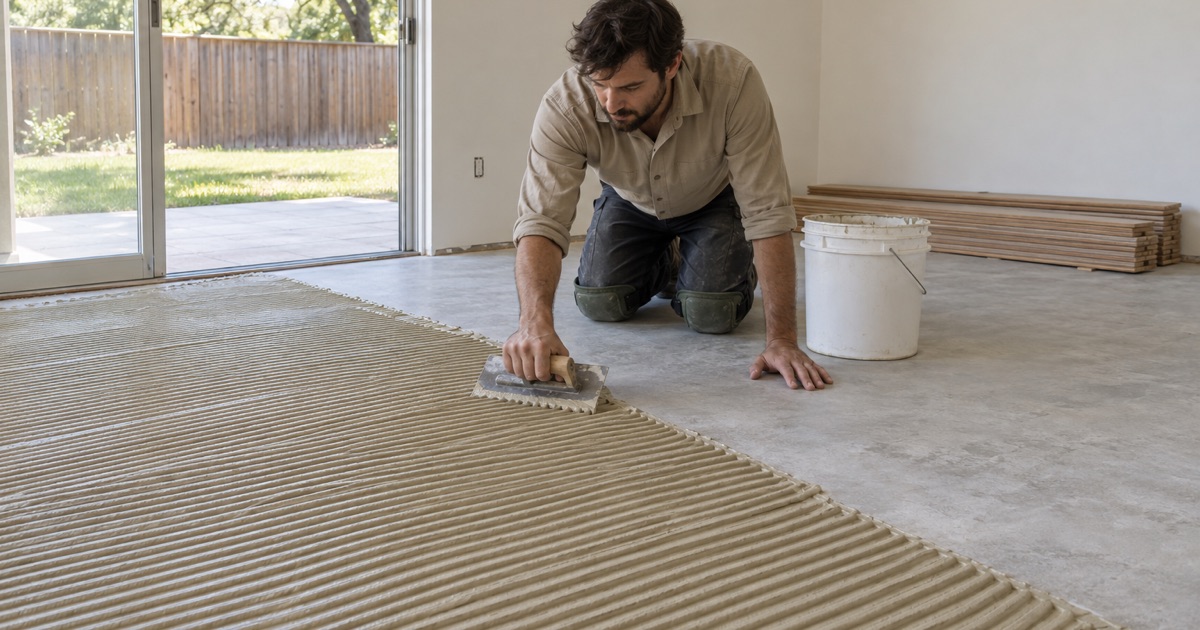
A glue-down floor is bonded directly to the slab with a trowel-applied adhesive, often one that doubles as a moisture barrier. It gives the most solid underfoot feel, the quietest room and the lowest floor height, and it is our usual recommendation where the slab tests dry enough and flat enough to take it. Its weak point is the bond, which is exactly why the moisture number is taken before the adhesive is chosen rather than after.
Floating Floors and Underlayment
A floating floor locks board to board and rests on an underlayment rather than attaching to the slab at all. It goes down quickly, tolerates a slab we would not glue to, and can be lifted later. It also needs a generous expansion gap at every wall and obstruction, and it can sound hollow over a large open plan. Choosing a denser underlayment and keeping the substrate flat are what keep that sound down.
Nail-Down Over Plywood Sleepers or a Wood Subfloor
Where there is a wood subfloor, upstairs or in the older housing near the old townsite, engineered flooring can be fastened down with cleats or staples on a proper fastener spacing schedule. Over a slab the same result is reached by building plywood sleepers or a full plywood subfloor first, with a vapor retarder beneath. That raises the finished floor height, which then has to be reconciled at every door, threshold and stair nosing.
Moisture, Vapor and the Slab Underneath
ASTM F2170 Testing Before a Date Is Set
We test the slab with an ASTM F2170 in-situ relative humidity test, probes drilled to depth and left to equilibrate, and record the result in writing before an installation date is committed. A calcium chloride test is added where it tells us something more. A reading inside the limit the flooring and adhesive manufacturers publish opens up the options; a wetter one narrows them or moves the date. The reading, not the calendar, sets the specification.
Vapor Retarders and Moisture-Control Adhesives
Something always sits between concrete and wood. On a floating or sleeper system that is a sheet vapor retarder lapped and sealed; on a glue-down it is usually a moisture-control adhesive applied at a specified trowel rate, or a separate roll-on membrane under a standard adhesive. The product is selected against the tested number and applied at the coverage the manufacturer requires, because under-applying it is a silent failure that surfaces as bond line failure later.
Post-Tension Slabs and What Can Be Fastened
Newer construction across this area is frequently post-tension slab, with tensioned steel cables running inside the concrete. Drilling or driving into one is a structural and safety event, not a nuisance. On those slabs we plan around glue-down or floating systems, and anything that must be anchored is located and scanned first. On a conventionally reinforced slab the constraints are different, which is why we establish which one you have before specifying.
Choosing Engineered Flooring for Your House
Wide Plank, Herringbone and Chevron in Engineered
Engineered construction is what makes a genuinely wide plank practical over a slab, because the stable core holds a seven- or nine-inch board far better than solid wood of the same width. The same stability helps with herringbone and chevron, where every piece has to stay square to its neighbors. Both patterns demand a flatter substrate and a carefully set centerline, and both consume noticeably more labor than a straight lay.
Prefinished Against Site-Finished Engineered
Most engineered flooring arrives prefinished, with a factory-cured coating and a micro-beveled edge at every seam. It installs fast and the house is usable immediately. Engineered flooring with a thick enough wear layer can also be site-finished, which gives a flat surface with no bevels and lets the stain and sheen be made in the room. That route is what we reach for when new flooring has to match something already down.
Formaldehyde Standards and Finish Chemistry
The plywood core is a composite wood product, and composite wood sold here falls under the TSCA Title VI formaldehyde standard. Coatings are separately limited by the federal AIM rule under 40 CFR 59 Subpart D, which caps the volatile content of products such as varnish at 450 grams per liter. We specify to both, and where indoor air quality is a household priority we steer the finish system toward waterborne polyurethane or a hardwax oil.
- 20+ Years in North Texas
- Dustless Sanding
- Free Written Estimates