
Grapevine Wood Flooring builds, replaces and refinishes hardwood stairs in Grapevine, TX and has been doing it for more than 20 years, serving surrounding cities including Southlake, Colleyville, Coppell, Euless, Trophy Club. Stairs are the part of a flooring project that most often gets postponed, then done badly by somebody else, then done again. They are hand work from the first cut to the last coat, and they sit at eye level in the entry of most two-story houses.
They also have to agree with the floor they land on. A tread that is a shade off, a nosing profile that does not match the flooring’s edge, or a riser painted a white that fights the trim in the hall will be the first thing a visitor notices. The reliable way to prevent that is to finish the stairs with the floor, in the same room and the same conditions, so the color is made once.
And they have to be right dimensionally. Stairs are the one flooring surface where a small inconsistency is a trip hazard rather than a cosmetic issue, so the geometry gets checked before the material is ordered rather than discovered when a retread lands proud of the one below it.
What Goes Into a Hardwood Staircase
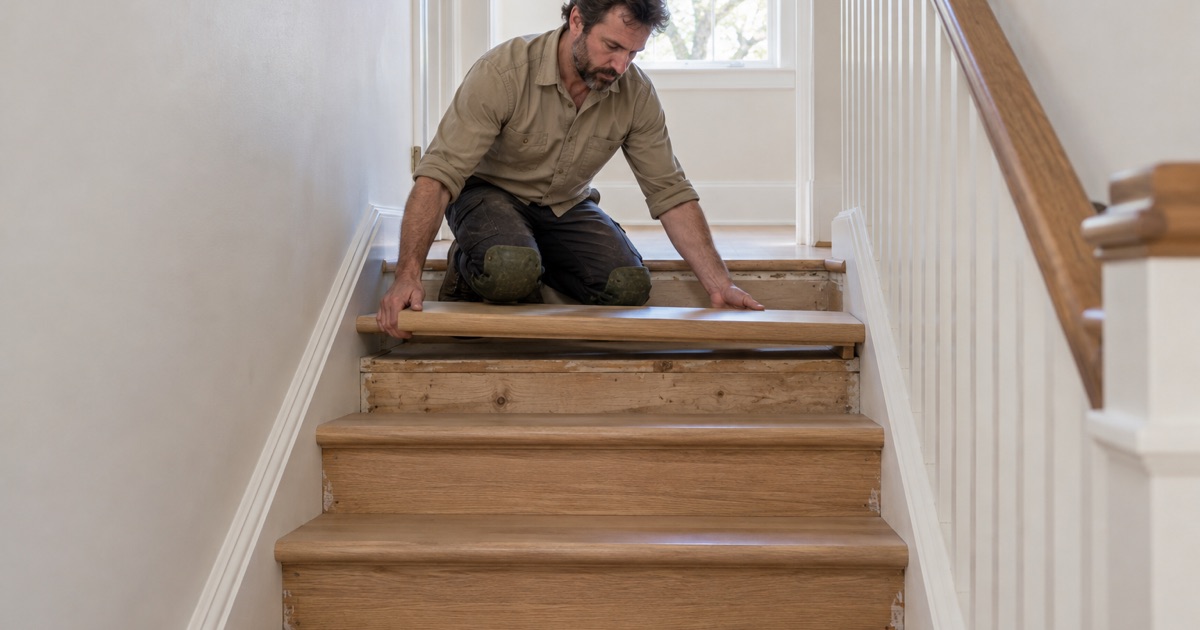
Treads, Risers and the Nosing That Joins Them
The tread is the surface you step on, the riser is the vertical face between treads, and the nosing is the rounded or profiled front edge that projects over the riser below. The nosing does most of the visual work, because it is what you actually see from the bottom of the flight, and its profile should relate to the flooring at the top landing. Each of the three is fitted individually to walls that are almost never square.
Stringers, Skirt Boards and the Wall Side
The stringers are the sawtooth framing members carrying the treads and risers, and they set the geometry of the whole flight. On the wall side, a skirt board runs the rake of the stair and hides the joint between treads and drywall. Scribing that skirt to the actual wall and the actual tread line is fussy work, and it is the detail that separates a finished-looking stair from one with caulk filling the gaps.
Balusters, Newel Posts and Handrails
Balusters are the vertical members between the treads and the handrail, the newel post is the heavy post anchoring the rail at the bottom, turns and top, and together they carry the load a handrail is required to resist. On a retread or refinish they frequently have to be removed and reset, because treads cannot be replaced around them. We plan that removal in advance so the rail system goes back solid rather than shimmed.
Carpeted Stairs Converted to Hardwood
What Is Actually Under the Carpet
In subdivision construction from the 1980s onward, stairs under carpet are usually built with construction-grade treads and open or unfinished risers, because nobody expected them to be seen. Pulling the carpet reveals staples, tack strip, glue and sometimes a tread that is out of level. That is normal, not a disaster, but it does mean a carpeted stair is rarely a sand-and-finish job and almost always a retread or replacement.
Retread Against Full Replacement
A retread caps the existing structure with new hardwood treads and riser faces, keeping the stringers and framing. It is quicker, cheaper and less disruptive, and it adds a small amount of height to each step, which has to be checked so the flight stays consistent. Full replacement takes the treads and risers out and rebuilds them, and it is the right choice when the existing geometry is inconsistent or the structure is damaged.
Matching the Stairs to the Floor They Land On
A staircase reads as part of the floor it meets, so species, cut, stain and sheen all have to line up at the landing. Where the floor is site-finished, we finish the stairs at the same time and the match is made in the room. Where the floor is prefinished, we source stair parts in the same product line and accept that a small difference is normal, rather than pretending otherwise afterward.
Geometry, Safety and Getting It Right the First Time
Riser Height and Tread Depth Consistency
People climb stairs by feel rather than by looking, so the hazard on a staircase is not a step that is tall or short but a step that differs from the ones around it. Residential code limits how much riser height and tread depth may vary within a single flight for exactly that reason. Adding a retread cap changes those dimensions, so we measure the whole flight before ordering and adjust rather than discovering the problem at the top step.
Nosing Projection and Slip Resistance
The nosing projects past the riser below it, and how far it projects is both a code matter and a comfort one: too little and the usable tread depth shrinks, too much and it catches a toe. On the surface, sheen affects how slick a stair feels underfoot more than most people expect, which is why matte and satin are the usual recommendation on a staircase even where the adjoining floor is glossier.
Landings, Winders and Curved Stairs
A straight flight is the simplest case. Landings need the flooring laid out so the pattern and direction relate sensibly to both flights. Winders, the triangular treads that turn a corner, and curved or flared stairs are considerably more work: every piece is a different shape, templates are made on site, and nosings have to be mitered and returned. We template rather than measure on anything that is not a straight run.
Finishing Stairs and Living With Them
Site-Finished Against Prefinished Stair Parts
Site-finished stairs are installed raw, then sanded, stained and coated in place, which produces a continuous surface with no bevels and lets the color be matched to the floor exactly. Prefinished treads arrive coated and go in fast, which shortens the time the staircase is out of service. The trade-off is straightforward: site-finished for the best match and flattest result, prefinished for schedule.
Choosing a Finish That Survives Stair Traffic
Stairs take concentrated wear in a narrow band across each tread, so the finish system matters more here than on an open floor. Waterborne polyurethane builds quickly and holds color; oil-modified polyurethane ambers and takes longer between coats, which extends the time a household is routed around the stairs; hardwax oil can be spot-repaired on a worn tread without recoating the whole flight. Household traffic decides it.
Refinishing and Repairing Stairs You Already Have
An existing hardwood stair can often be brought back rather than replaced. We check remaining tread thickness the way we check a floor, sand by hand and with an orbital sander where a drum cannot reach, replace any individual tread that is split or worn through, re-secure loose balusters into the newel post and treads, and correct squeaks by refastening the tread to the stringer and filling the fasteners.
- 20+ Years in North Texas
- Dustless Sanding
- Free Written Estimates