
Grapevine Wood Flooring has been sanding and refinishing hardwood floors in Grapevine, TX for more than 20 years, serving surrounding cities including Southlake, Colleyville, Coppell, Euless, Trophy Club. Refinishing is the service where the difference between crews shows up latest and costs most: a floor that was sanded too aggressively, coated too soon or finished over the wrong sealer looks fine on handover day and tells on itself a season later.
So we start by measuring rather than quoting. On engineered flooring we check wear layer thickness at a transition or a pulled board before we put a price on anything, because under about three millimeters there is no sanding life to sell. On solid wood we check how much board is left above the tongue. Those two numbers decide whether you are buying a refinish, a recoat, or a conversation about replacement.
One crew carries the job from the first grit to the final coat, and the sanding is never subcontracted out. Containment goes up and gets shown to you before a machine runs, and a written cure and occupancy schedule is handed over before the first coat goes down, so the day furniture, rugs and pets come back is a date rather than a guess.
What Refinishing Can and Cannot Fix
Solid Hardwood and the Sanding Life Left In It
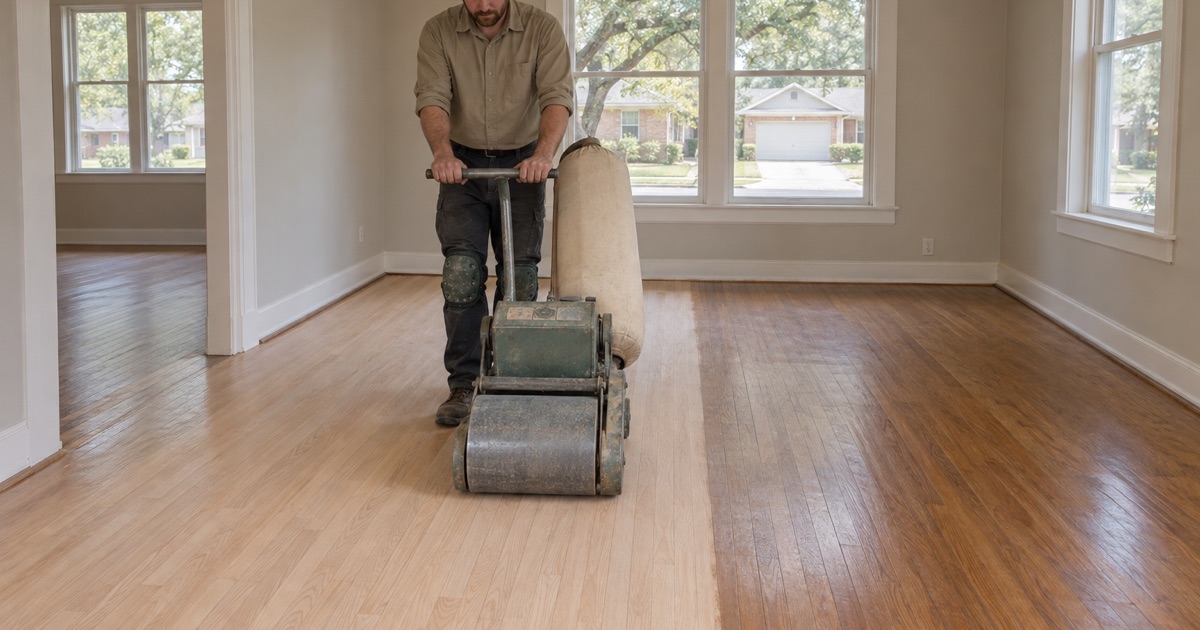
Solid boards are wood all the way through down to the tongue, and every full sand takes a thin slice off that remaining thickness. We measure at a floor vent, a stair nosing or a threshold where the edge of a board is visible, and we tell you how many sands are realistically left. A floor with plenty of life can take a full 36-50-80 grit sequence now and again in a decade; a floor near the end of it is better served by a light abrasion and a fresh coat.
Engineered Flooring and Wear Layer Thickness
Engineered flooring is a hardwood wear layer over a plywood core, and the sanding you can do is limited entirely by that layer. Six millimeters behaves much like solid wood for one full sand. Three millimeters allows a single careful pass with tight depth control. Two millimeters does not, and forcing it produces sand-through to the plywood core in the traffic lanes and lathe checks opening across the veneer where the rotary cut was made.
Damage That Needs Board Work Before Any Sanding
Sanding removes finish and a thin layer of wood; it does not fix a broken board, a black pet stain that has gone through the wear layer, or a cupped floor that is still wet underneath. We identify those first and handle them as board replacement, a weave-in or a dutchman patch, and we resolve any moisture source before the machines come out. Sanding a floor that is still moving simply locks the distortion in at a new thickness.
Screen-and-Recoat or a Full Sand
When a Screen-and-Recoat Is the Right Call
A screen-and-recoat abrades the existing finish with a buffer and adds one or two fresh coats over it. No wood is removed, the floor is back in service in a fraction of the time, and the cost is well under a full refinish. It works when the wear has stayed in the finish film and has not reached the wood itself. We abrade a test section and coat it before recommending it, because the wrong call here seals damage under a new surface.
The 36-50-80 Grit Sequence on a Full Sand
A full sand starts coarse enough to cut through the old finish and level the floor, then steps down through progressively finer abrasives so each pass removes the scratch pattern the last one left. Skipping a grit to save time leaves deeper scratches under the finish that only appear once the coating goes on and the light catches them. We run the sequence out and check the floor between passes rather than assuming the machine did its job.
Drum Sander, Edger, Orbital Sander and Buffer
The drum sander does the field, the edger reaches what the drum cannot along the walls and under toe kicks, and corners come out by hand. Where the floor is thin, delicate or historic we work with an orbital sander instead of a drum for a gentler cut. The buffer blends the field and the perimeter so there is no visible ring where the machines changed, which is the most common tell of a rushed refinish.
Choosing the Finish for Your Floor
Waterborne Polyurethane
Waterborne polyurethane dries fast, carries far less odor through the house and stays close to clear, so white oak stays pale rather than warming. That clarity is why it suits the light and natural tones most North Texas renovations are asking for now. It also means coats can be built up over a short window, which shortens the time the house is out of use compared with a slower-drying system.
Oil-Modified Polyurethane and Hardwax Oil
Oil-modified polyurethane ambers as it ages, which many owners want on red oak and on older floors where the warm tone is part of the character. It takes longer between coats and carries more odor while it cures. Hardwax oil penetrates the wood rather than forming a film on top, gives a low natural sheen, and can be spot-repaired in a worn area without recoating the whole room.
Stain Color, Sheen and Testing on Your Own Floor
Stain looks different on your floor than on any sample, because species, age and prior finish all change how it takes. We lay test patches on the actual sanded wood, in the actual room, and look at them in daylight and at night before anything is committed. Sheen is chosen the same way: matte hides scratches and dust best, satin sits in the middle, and semi-gloss shows every scuff in a room with long sightlines.
Dust, Cure Time and Getting the House Back
Dustless Containment on Every Sanding Job
Every sanding job is contained before the first machine starts. Drum, edger, orbital and buffer all run to vacuum collection, doorways and returns are sealed, and we walk you through the setup rather than describing it after the fact. Fine sanding dust is the part of this work that spreads furthest through a house and takes longest to clean up, and containment is what keeps it in the room being worked.
Cure Time Versus Dry Time
Dry means the coat has released its solvent or water and will not mark under light traffic. Cure means the finish has reached its full hardness and chemical resistance, and that takes considerably longer. Furniture legs, rug backings and dog claws on a floor that is dry but not cured leave marks that do not buff out. The written schedule we hand over separates the two and gives dates for each stage.
Older Grapevine Houses and the Lead-Safe Rule
This city has 651 housing units built before 1960 and 127 dating to 1939 or earlier, largely in and around the old townsite, so pre-1978 construction is a genuine part of the work here rather than a rarity. Where refinishing disturbs painted components in that housing we follow the EPA RRP lead-safe rule for containment and cleanup. Original site-finished pine and oak in those houses is salvaged and reworked wherever it can be rather than replaced.
- 20+ Years in North Texas
- Dustless Sanding
- Free Written Estimates