
Grapevine Wood Flooring installs wide plank flooring and pattern floors across Grapevine, TX, and after more than 20 years of putting wood over North Texas slabs we have a settled view on it: wide plank and herringbone are excellent choices when they are specified and installed for the conditions, and among the fastest floors to fail when they are treated as a straight-lay job with different boards.
The reason is geometry. A wood board expands and contracts across its width rather than along its length, so doubling the width roughly doubles the movement at every seam. Pattern floors add a second demand: every piece has to stay square to its neighbors across the whole room, which turns a substrate that was merely acceptable into one that shows every wave.
So the work here sits mostly in preparation. Substrate flatness gets corrected rather than tolerated, moisture gets tested and recorded before a date is set, material acclimates inside the room it is going into, and the fastening or adhesive schedule is chosen for the width actually being installed. Done that way, a nine-inch white oak floor is a floor you stop thinking about.
How Wide Is Too Wide
Board Width and Seasonal Movement
Wood takes up and gives off moisture until it reaches equilibrium with the air around it, and the dimensional result shows up across the grain. In practice that means a wide board opens a wider seasonal gap and cups more visibly than a narrow one under identical conditions. The answer is not to avoid width but to control the variables that drive movement: tested moisture, acclimation in the room, and a house that is conditioned normally year round.
Engineered Wide Plank Over a Slab
Engineered construction is what makes genuinely wide boards practical over concrete. The cross-laminated plywood core restrains movement across the face, so a seven- or nine-inch engineered board behaves far more predictably than solid wood of the same width. Wear layer thickness still governs whether the floor can ever be sanded, so we check for a six millimeter layer where refinishing later matters and say plainly when a product is recoat-only.
Quartersawn and Rift Sawn Solid Wood
Where solid wood is wanted in a wide format, how the board was cut from the log matters as much as the species. Plainsawn boards move most across their width and are the most likely to cup. Quartersawn and rift sawn boards are cut so the growth rings run closer to vertical through the thickness, which trades yield and cost for markedly better dimensional stability and a straighter grain pattern.
Herringbone, Chevron and Other Patterns
Herringbone Against Chevron
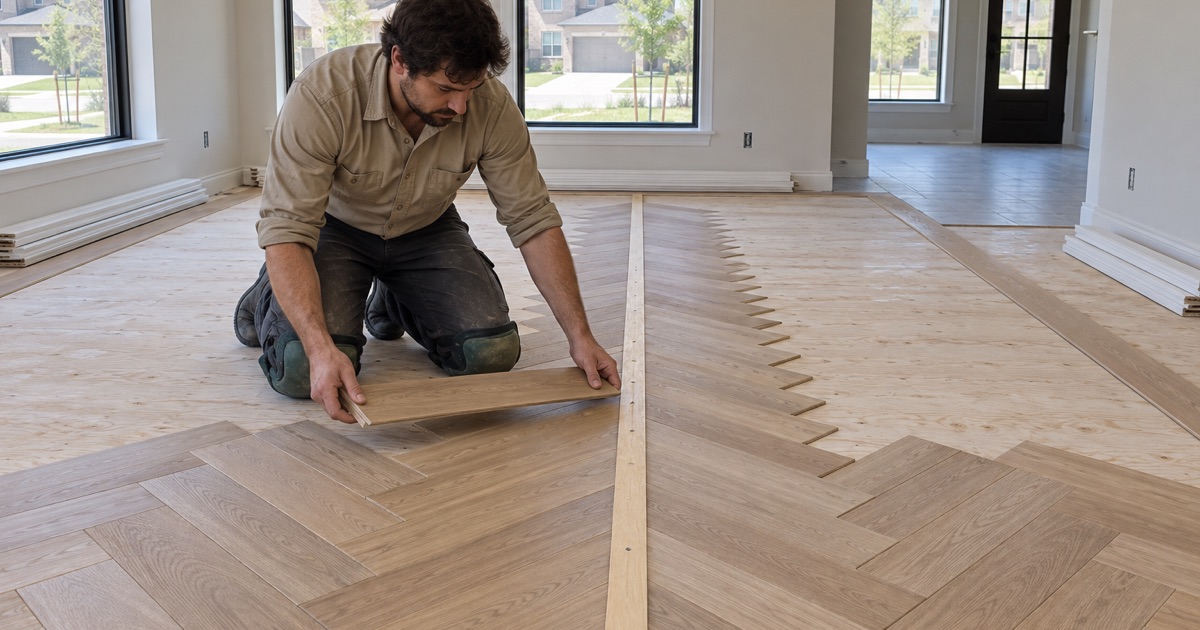
Herringbone sets square-ended rectangular boards at right angles to one another in a staggered zigzag, so each piece meets the side of its neighbor. Chevron miters the ends so the points meet tip to tip and form an unbroken V running down the room. Chevron reads more formal and more directional; herringbone is more forgiving to install and more common. Both need considerably more labor than a straight lay.
Layout, Centerlines and Waste
A pattern floor is set out from the room rather than from a wall, because walls in a finished house are rarely parallel and the eye reads the pattern’s center line, not the baseboard. We snap working lines, dry-lay the field, and confirm how the pattern lands at doorways and at the fireplace before fastening anything. Angled cuts also raise material waste, which is budgeted at the order rather than discovered mid-installation.
Borders, Feature Strips and Transitions
A pattern field usually wants a border to close it off cleanly at the walls, and a straight-laid perimeter band gives the pattern a defined edge and absorbs the irregularity of the room. Where a pattern meets a straight-laid floor in an adjoining space, a threshold or a feature strip makes the change deliberate. We plan those junctions at layout, because a pattern that simply stops at a doorway looks unfinished.
Installing Wide and Patterned Floors Properly
Flatness and Substrate Preparation
Every flooring manufacturer publishes a flatness tolerance, and wide and patterned floors are the least forgiving of a substrate that misses it. A dip that a three-inch strip floor bridges without complaint becomes a hollow spot, a rocking board or a broken locking joint under a nine-inch plank. We straightedge the room, grind the high areas and pour self-leveling underlayment across the low ones before any material is opened.
Adhesive, Cleats and the Fastening Schedule
Wide boards need more holding force per board than narrow ones. On a nail-down installation that means a tighter fastener spacing schedule and the correct cleat or staple gauge and crown width for the thickness, rather than the spacing a strip floor would get. On a glue-down installation it means a full-spread adhesive at the specified trowel notch and coverage rate, with boards rolled or weighted so nothing bridges while it cures.
Acclimation and Expansion Gaps
Material is delivered early and left inside the house, in the room it is going into, with the HVAC running as it normally would, until its moisture content settles. Wide boards punish a rushed acclimation more than any other format. The perimeter expansion gap is then sized against species, width and the readings taken on site, and kept continuous behind base and shoe molding at every wall, column and threshold.
- 20+ Years in North Texas
- Dustless Sanding
- Free Written Estimates